Twelve French Idioms You Owe to the Most Famous French Poet

Rien ne sert de courir, il ne faut pas vendre la peau de l’ours avant de l’avoir tué… What if I told you that all these difficult-to-remember idioms have something in common? More, their origin traces back to a monument of French literature & culture that you won’t be able to ignore for long if you live in France: Jean De La Fontaine, the most famous French storyteller.

Statue of La Fontaine in Paris’s 16ème arrondissement
La Fontaine (1621 – 1695) published his Fables in several collections between 1668 and 1694, borrowing plots from Aesop, the Indian Panchatantra, and creating his own, then reworking them into elegant, witty French verse. On the surface they’re charming little animal stories. Underneath, they’re sharp commentary on human vanity, power, and folly.
Nearly every French child memorizes a few of these fables in school, which is why their punchlines have soaked into the language itself. Native speakers drop these phrases without ever thinking about the poems they come from – the way English speakers say “sour grapes” or “the boy who cried wolf.” Learn a few of them and you’ll suddenly understand jokes, headlines, and grandparents.
Here are some of the most useful, still in daily circulation.
1. Faire la mouche du coche
From “Le Coche et la Mouche” (The Coach and the Fly)
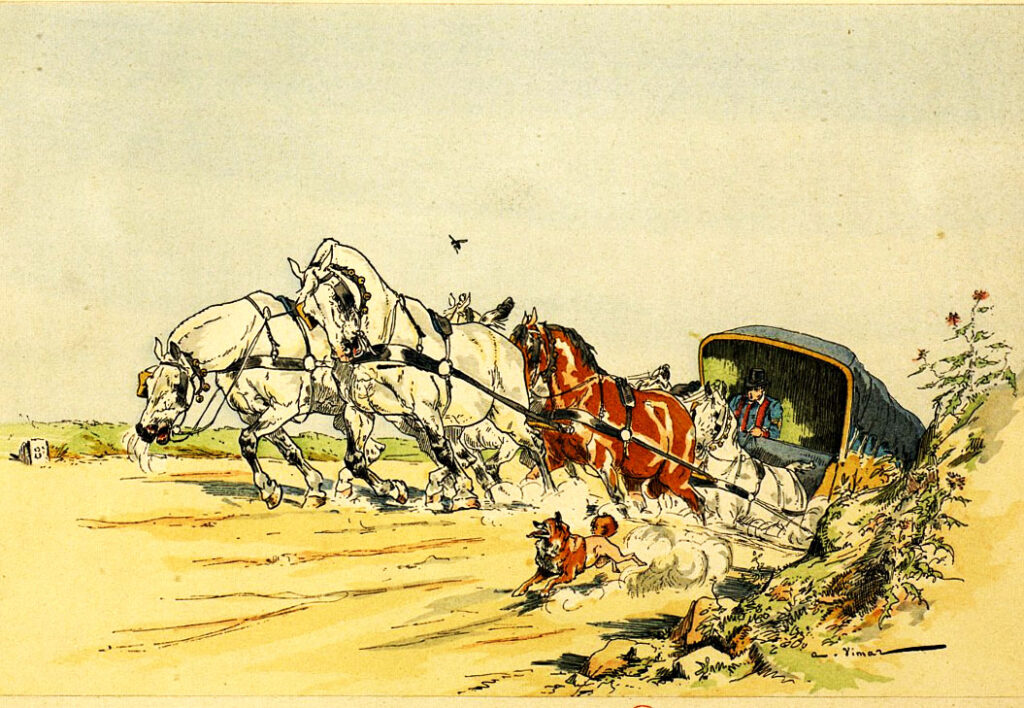
Illustration by Vimard, Le coche et la mouche
Literal translation: To act like the fly on the coach.
What it means: To make a great fuss about being busy and important while contributing nothing to the actual work. The self-appointed supervisor who takes credit for other people’s effort.
The story: A stagecoach is straining up a steep, sandy hill. A fly buzzes around the struggling horses, landing on their noses, zipping back and forth, congratulating itself for driving the whole operation forward. When the coach finally reaches the top, the fly demands its reward – convinced that its heroic buzzing is what got everyone there. The horses, of course, did all the work.
So, more simply, next time somebody advises you on how to peel potatoes for your French gratin properly without holding any, don’t hesitate to pull that phrase out: eh, arrête de faire la mouche du coche !
2. Vouloir être aussi gros que le bœuf
From “La Grenouille qui veut se faire aussi grosse que le Bœuf” (The Frog Who Wanted to Be as Big as the Ox)
Literal translation: To want to be as big as the ox.
What it means: To overreach – to strain ridiculously to match someone bigger, richer, or more powerful than you, usually with disastrous results.
The story: A frog spots an ox and is seized with envy at its size. Determined to match it, she puffs herself up, swelling and swelling, asking her sister each time, “Am I there yet? Look, am I as big now?” She isn’t, and she keeps inflating – until she bursts.
If your work colleague took a loan to buy a better car than your boss, even if you don’t say it, you may think with conviction that they’re trying to être aussi grosse que le boeuf.
3. Crier haro sur le baudet
From “Les Animaux malades de la peste” (The Animals Sick with the Plague)
Literal translation: To cry “haro” upon the donkey. (“Haro” was an old Norman legal cry raising a hue and to demand justice against someone)
What it means: To pile onto a scapegoat – to collectively condemn one convenient, defenseless victim for a problem everyone shares.
The story: A plague ravages the animal kingdom. The lion proposes that everyone confess their sins so the guiltiest can be sacrificed to appease heaven. The lion admits to eating sheep (and the occasional shepherd); the fox flatters him and explains this was really an honor for the sheep. The powerful predators all excuse each other. Then the humble donkey confesses that, one hungry day, he ate a little grass from a monastery meadow. Horror! The others immediately decide he is the true criminal, and he’s condemned to death. The moral: whether the court declares you innocent or guilty depends on whether you’re powerful or wretched.
The whole department missed the deadline, but the intern forgot to CC one email — so naturally everyone crie haro sur le Baudet and forgets who actually dropped the ball.
4. La raison du plus fort est toujours la meilleure
From “Le Loup et l’Agneau” (The Wolf and the Lamb)
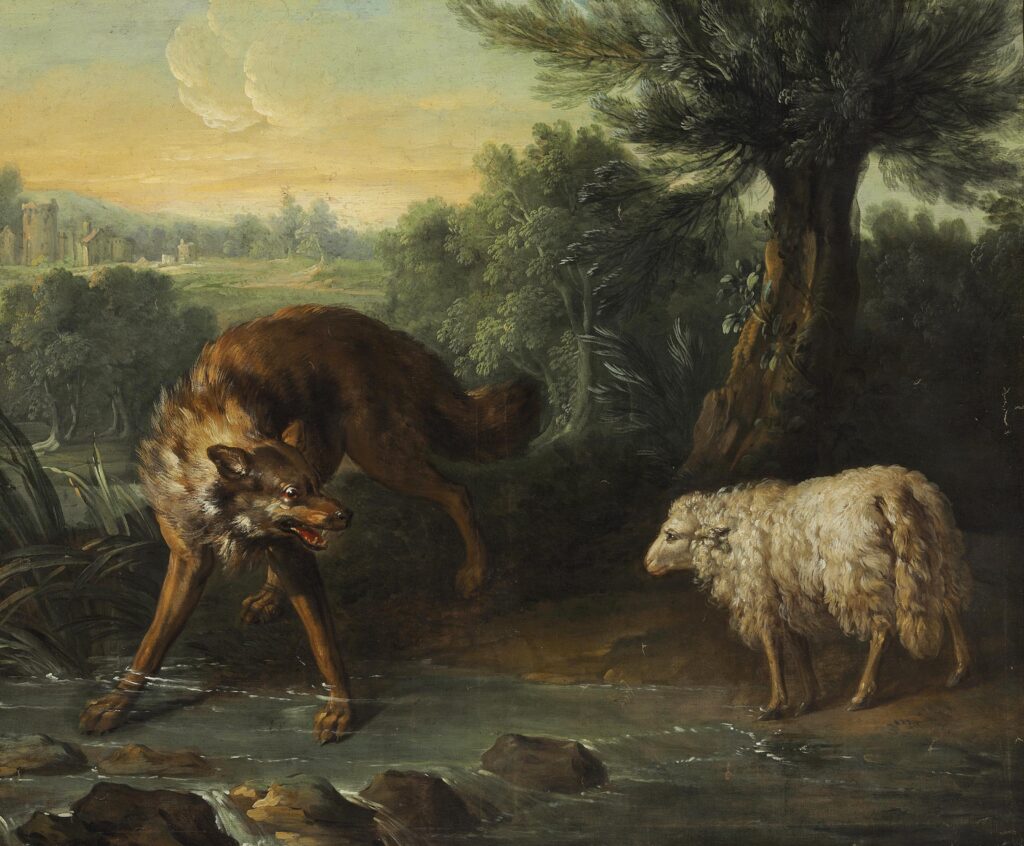
Le loup et l’agneau, painting by Jean-Baptiste Oudry, 1747
Literal translation: The reasoning of the strongest is always the best.
What it means: Might makes right. When someone powerful wants something, their “argument” wins no matter how absurd it is.
The story: A lamb is drinking at a stream. A wolf appears upstream and accuses the lamb of muddying his water. The lamb points out, politely, that he’s drinking downstream, so that’s physically impossible. The wolf switches accusations: “You insulted me last year.” “I wasn’t born last year.” “Then it was your brother.” “I don’t have one.” “Then it was someone in your family.” Out of patience and pretexts, the wolf simply drags the lamb into the woods and eats him. No trial needed.
Next time the cops pull you over and end up giving you a fine for no reason, remember – although bitterly – that La raison du plus fort est toujours la meilleure.
5. Aide-toi, le ciel t’aidera
From “Le Chartier embourbé” (The Carter Stuck in the Mud)
Literal translation: Help yourself, and heaven will help you.
What it means: Heaven helps those who help themselves. Don’t just pray for a solution – get to work, and then fortune may assist you.
The story: A carter’s wagon gets stuck deep in the mud. Helpless, he cries out to Hercules for aid. A voice from the sky answers: stop whining. Check your wheels, clear the mud, remove the rock jamming the axle, use your pick and your shoulder. The carter does all this, the wagon moves, and the voice concludes: now you see how heaven helps.
Now you know what to answer when your French niece cries for your help for her English homework.
6. Montrer patte blanche
From “Le Loup, la Chèvre et les Chevreaux” (The Wolf, the Goat, and the Kids)
Literal translation: To show a white paw.
What it means: To prove your identity or provide the correct credentials before being let in or trusted – further, to do something to lift people’s distrust.
The story: A mother goat leaves her kids at home, warning them to open the door for no one unless the visitor gives the password and shows a white paw – because their enemy the wolf has grey paws. Sure enough, the wolf comes knocking, having learned the password by eavesdropping. But when the kids ask to see a paw under the door, they see it’s grey, and refuse to open. The wolf goes hungry. Suspicion, for once, pays off.
If you’re invited to a dinner you know nobody at, don’t hesitate to montrer patte blanche by bringing a nice bottle of wine!
7. Il ne faut pas vendre la peau de l’ours avant de l’avoir tué
From “L’Ours et les deux Compagnons” (The Bear and the Two Companions)
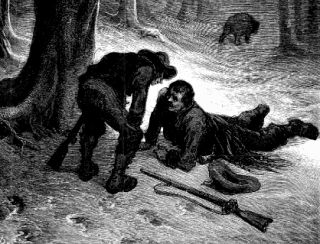
L’Ours et les deux compagnons illustrated by artist Gustave Doré, 1866 – 1867
Literal translation: One must not sell the bear’s skin before having killed it.
What it means: Don’t count your chickens before they hatch. Don’t spend or celebrate a reward you haven’t actually secured yet.
The story: Two friends, short on cash, sell a furrier the skin of a bear they haven’t caught yet, promising to deliver soon. They go hunting. The bear finds them first. One man scrambles up a tree; the other, unable to run, throws himself to the ground and plays dead. The bear sniffs him, decides the “corpse” is no fun, and lumbers off. The friend in the tree climbs down and asks what the bear whispered in his ear. The reply: it told me never to sell the bear’s skin until the bear is dead.
Next time a friend predicts he’s about to beat you at a chess game, don’t forget to remind them to not underestimate their opponent with that idiom.
8. Rien ne sert de courir, il faut partir à point
From “Le Lièvre et la Tortue” (The Hare and the Tortoise)
Literal translation: There’s no use running; you have to leave on time.
What it means: Speed is worthless without timing. Steady, well-planned effort beats a burst of last-minute panic. This is the fable’s famous opening line.
The story: You know this one. The hare, mocking the slow tortoise, agrees to a race. So confident is he in his speed that he stops to graze, naps, and dawdles, sure he can win whenever he likes. The tortoise never stops moving. By the time the hare bolts awake and sprints for the finish, the tortoise has already crossed it.
Next time your child hurries you up so not to be late at school after spending 30 minutes in the shower, kindly remind them that rien ne sert de courir.
9. Tout flatteur vit aux dépens de celui qui l’écoute
From “Le Corbeau et le Renard” (The Raven and the Fox)
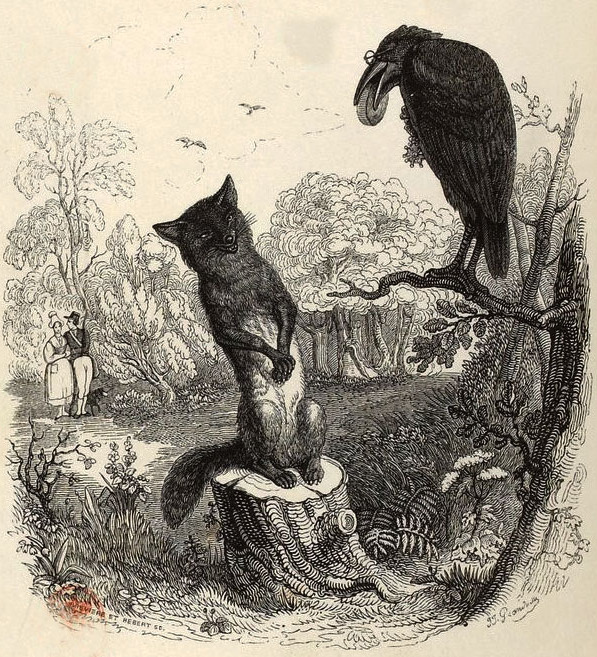
Le corbeau et le renard illustrated by Grandville, 1837
Literal translation: Every flatterer lives at the expense of the one who listens to him.
What it means: Flattery is never free – the flatterer is after something, and the person lapping it up is the one who pays.
The story: A crow sits in a tree holding a lovely piece of cheese in its beak. A fox below, drawn by the smell, begins praising the crow’s beauty: such glorious feathers! If your voice matches your looks, you must be the phoenix of these woods! Overcome with pride, the crow opens its beak to sing – and drops the cheese, which the fox snaps up. As payment, the fox delivers the moral, and the humiliated crow swears (too late) never to be caught that way again. The last sentence of the fox even says “this lesson’s probably worth a cheese, no doubt” – can there be something more French?
So, if somebody at work keeps complementing you on how smart and skillful you are, keep in a corner of your head that their flattery may have a hidden purpose.
10. Tel est pris qui croyait prendre
From “Le Rat et l’Huître” (The Rat and the Oyster)
Literal translation: He who thought to trap is himself trapped.
What it means: The trickster gets caught in his own trick. The would-be predator becomes the prey.
The story: A naïve country rat, proud of leaving his field to see the world, comes across an open oyster on the shore. Mistaking it for a delicious treat and showing off his sophistication, he pokes his head inside to take a bite. The oyster snaps shut on his head, trapping him – and there he stays, caught by the very thing he meant to eat.
A perfect sentence for an April fool day.
11. Patience et longueur de temps font mieux que force ni que rage
From “Le Lion et le Rat” (The Lion and the Rat)
Literal translation: Patience and length of time do more than force or than rage.
What it means: Persistence and time accomplish what brute strength and fury cannot.
The story: A tiny rat blunders out between a lion’s paws. The lion, in a generous mood, spares the little creature’s life. Later, the lion is caught in a hunter’s net, roaring and thrashing with all his might – and getting nowhere. The rat hears him, comes running, and patiently gnaws through the ropes one strand at a time until the mighty lion is free. What raw power couldn’t do, small teeth and patience did.
If you’re angry at yourself because you keep forgetting the French vocabulary you learn in class, remember that patience et longueur de temps font mieux que force ni que rage.
12. Tirer les marrons du feu
From “Le Singe et le Chat” (The Monkey and the Cat)
Literal translation: To pull the chestnuts out of the fire.
What it means: Careful – this one has drifted. In La Fontaine’s original sense, it means to do the dangerous, painful work while someone else enjoys the reward: to be someone’s dupe. In modern usage, French speakers often use it to mean the opposite – to skillfully get yourself out of a tricky situation, or to grab the advantage. Context tells you which.
The story: Bertrand the monkey and Raton the cat watch chestnuts roasting in the fireplace. Bertrand flatters Raton into fishing them out of the embers. The cat burns his paw pulling each chestnut from the fire – and the monkey eats every one as fast as they come out. A servant arrives, and both scamper off. The cat got nothing but singed fur; the monkey got the feast.
“I did all the research, my teammate presented it and got promoted. I pulled the chestnuts out of the fire and he ate them.”
French people consider these sayings as little pearls of wiseness, so expect to hear or read them quite often. As this week’s challenge, try to see if you manage to fit any of these in a conversation or a piece of writing, or if you come across one in the comment section of a newspaper article you got hooked by.




Responses