Les Bleus: A Nation’s Favorite Argument

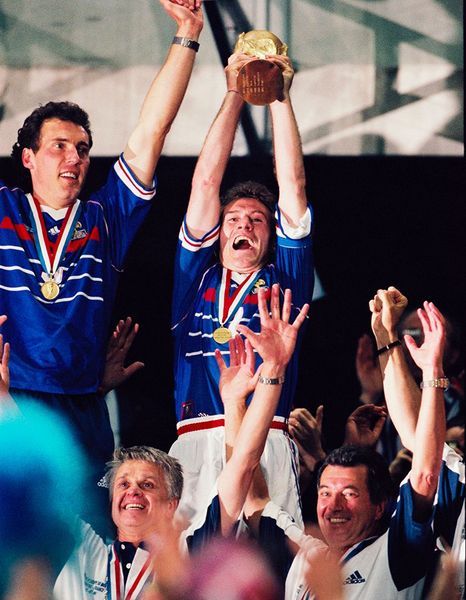
Football wasn’t always France’s sport. For decades, it was regarded with skepticism by most French as déclassé. Roland Garros, the Tour de France, anything with more elegance and less mud. Worse: Les Bleus (the team’s nickname) kept choking on the big stage, tournament after tournament.
Then 1998 happened.
Home soil, home win, snobbery instantly dead. Football has been France’s undisputed favorite sport ever since. Nothing else gets a CEO, a retired professor, and a teenager screaming at the same TV. It’s basically a religion now, minus the church. But the French don’t do composure. Win, and the whole country turns into one big choir: “et un, et deux, et trois-zéro“. Players become legends overnight. The country feels, briefly, reunited.
Lose, though, and it’s a whole different story: every big tournament has a nasty habit of turning into a referendum. Particularly on identity, immigration, and what “being French” even means way – more than any other competition, for reasons you’re about to see. So if you’ve ever wondered why your street won’t shut up after a match, who this “Zinedine Zidane” guy is with a name that sounds like a French liaison, or what a coup de boule has to do with football – buckle up. Here’s everything you need to survive a football chat at a French dinner table.
1998 – The Birth of a Myth
France hosts, and wins, its first World Cup, thrashing Brazil 3-0 in the final: two headers from a rising star named Zinedine Zidane, and a third from Emmanuel Petit in stoppage time. The golden generation was born. The press immediately baptizes the multiethnic squad “Black, Blanc, Beur” and turns it into a parable of successful national integration. President Jacques Chirac, riding shockingly low approval ratings before, wastes no time capitalizing on the euphoria – he’s photographed kissing goalkeeper Fabien Barthez’s bald head in the dressing room (a ritual actually started by teammate Laurent Blanc) and is praised again by popular opinion. A nation convinces itself, for one summer, that maybe it isn’t such a bad country to be from after all.
2002 – The Forgettable Fiasco
The reigning champions arrive as overwhelming favorites and leave after the first round without scoring a single goal – still the most humiliating title defense in World Cup history. The generally agreed-upon culprits: a Zidane thigh injury, an aging back line, and an exhausted squad, over-used by clubs and federation alike in the two years since the 1998–2000 double. A thoroughly depressing, forgettable tournament.
2006 – The world class “coup d’boule”
Against all odds, an aging Bleus team fights its way back to the final. The old generation, reborn. Then, in his final professional match, Zidane headbutts Italian defender Marco Materazzi in the chest and gets sent off; David Trezeguet clangs the decisive penalty off the crossbar; France loses. The country reacts with heartbreak and, almost instantly, a debate about what it says about French pride. Political opposition figures wasted no time using the defeat as a metaphor for a country losing its footing under Chirac’s government, while commentators argued for months about whether Zidane’s loss of control was a personal failure or a strangely noble, quintessentially French way to go out swinging.
2010 & 2014 – The “Racaille” Years
If 1998 was the honeymoon, this was the ugly divorce. At the 2010 World Cup in South Africa, striker Nicolas Anelka is sent home after insulting coach Raymond Domenech. Outraged, the rest of the squad refuses to train, staging a strike on the team bus. The straw that broke the camel’s back, after a long career of such drama, rather than actual victories, for some of the players. The press and political class label them as racaille (thugs), and accuse them of bloated egos, and disloyalty to the shirt. On the field, the game is way under. Later, a leaked 2011 meeting reveals officials, including incoming coach Laurent Blanc, discussing informal quotas to limit the number of Black and Arab players coming up through the youth ranks, reigniting the whole “does this team even represent France” argument. Then, just for good measure, a 2015 blackmail scandal involving a compromising video of midfielder Mathieu Valbuena implicates teammate Karim Benzema, France’s best player of that era, who is convicted of complicity. Les Bleu’s image is long tarnished.
2018 – The Purge
New coach Didier Deschamps, former captain of the 1998 legendary team, rebuilds around a startlingly young, disciplined squad, deliberately leaving out more temperamental veterans – Benzema chief among them, still exiled over the Valbuena affair – in favor of collective structure. However, critics call the team too green to win anything; Deschamps himself admits before the tournament that half his squad has never played a World Cup match. The Benzema decision becomes a political lightning rod all its own: accusations of discrimination fly, and Deschamps’s own house is spray-painted with the word raciste, which, this time, the French public didn’t buy. On the field, the team starts shining again. France gloriously brings it home after a tight match VS Croatia, with a teenage Kylian Mbappé announcing himself as the sport’s next superstar.
2022 – Deschamps Elysées aux chants du cygne
A post-Covid tournament that France barely seems to enjoy playing in, grinding through matches with a cautious, defense-first, counter-attack-heavy style that becomes its own genre of debate. Les Bleus reach the final anyway and lose to Argentina on penalties, after Mbappé equalizes the score with 3 incredible goals in a row during the second half. Politically, the tournament becomes a showcase, as the immediately presidential election brought a weakened Macron back. Figures from the far right accuse the team’s ethnic makeup of not “resembling the country,” question the loyalty of French-Moroccan fans after the France–Morocco semi-final, and warn of integration failures among binationals. Yet, the critics can’t beat the praises from the sports press: despite their defeat, les Bleus performed impressively well during that difficult World Cup, and their restored reputation remained unaffected.
2026 – “On Arrive Méchants”
Deschamps, in his final tournament as coach, presides over a squad that has visibly learned from every scandal that came before it: egos parked at the door, team spirit over individual brilliance, and communication locked down tight, with players giving noticeably little unscripted airtime to the press. Their unofficial slogan, popularized by Mbappé himself on social media after a Round-of-16 win on arrive méchants (“we’re coming tough”) captures a group that talks about combativeness, not swagger. On the pitch it’s working spectacularly, with polling showing French confidence in a third star climbing tournament by tournament. You already know what happened, next.
If you’re not familiar with French football, that’s most of what you missed: Allez les bleus!


Responses